Want to build a compounding plan for your situation?
Talk to a bilingual coach — free, no strings attached, educationally focused.
Book your session →
You don't necessarily need a large amount of money to start building wealth. Understanding how time, consistency and financial decisions interact can change what you decide today.
Imagine someone offers you $1,000,000 today — or a penny that doubles every day for 30 days. Which do you choose?
Mathematical illustration only — no real investment doubles daily. The educational point is to show the shape of an exponential curve: nearly flat at the start, dramatic at the end.
The educational lesson isn't that you'll double your money daily — it's that compounding growth starts almost invisible and feels unexciting for a long time. If you abandon it before the curve lifts off, you miss the power. If you stay, the far end of the curve does most of the work.
That question changes the conversation: it stops being about "how much do I earn" and starts being about "when do I decide to start." Compounding doesn't reward the perfect amount. It rewards the early decision and consistency.
Compound interest is when you earn a return not only on your original money, but also on the return you've already earned. In other words: your gains start to generate gains. An educational example with a fixed 8% annual rate on $1,000 — with no additional contributions:
| Year | Starting balance | Growth this year | Ending balance |
|---|---|---|---|
| 1 | $1,000.00 | $80.00 | $1,080.00 |
| 2 | $1,080.00 | $86.40 | $1,166.40 |
| 3 | $1,166.40 | $93.31 | $1,259.71 |
Notice: the growth rises each year even though the rate is identical. That's what makes compound interest different from simple interest — simple interest would just generate $80 each year on the principal, unchanging.
An illustrative example: $5,000 invested once at a hypothetical 7% annual rate (compounded annually), with no further contributions:
Same money. Same hypothetical rate. The gap between 10 and 40 years is over $65,000 — purely from time. This is not a projection: actual returns vary year to year and may be lower (or higher). But it shows why time often matters as much as — or more than — the amount.
What if, instead of a single deposit, you contribute $100 a month? Illustrative example at a hypothetical 7% nominal annual rate (monthly compounding, end-of-month contributions):
| Years | Total contributions | Hypothetical balance | Potential growth |
|---|---|---|---|
| 10 | $12,000 | $17,308 | $5,308 |
| 20 | $24,000 | $52,093 | $28,093 |
| 30 | $36,000 | $121,997 | $85,997 |
| 40 | $48,000 | $259,625 | $211,625 |
At 10 years, most of the balance is your contributions. At 40, most is hypothetical growth — money that your money earned. That's the educational shape of compounding in action with regular contributions.
Compare two illustrative scenarios — same hypothetical 7% nominal annual rate (monthly compounding, end-of-month contributions):
Person A contributed only one third of what Person B did — and, under this illustration with the same rate, their hypothetical balance ends up about $37,000 higher. The variable that made the difference wasn't talent, salary or luck. It was time.
Educational example. Actual investment returns vary with the market and are not guaranteed; taxes, fees and inflation affect the outcome.
The same engine that grows an investment also grows a debt. When a high-APR credit card isn't paid in full each month, interest is added to the balance and next month's interest accrues on a larger balance. That's compounding in reverse.
Not all debt behaves the same — APR calculations vary by issuer, by product type (card, personal loan, mortgage, auto, student) and by contract terms. But the educational question is the same: is your money compounding for you or against you?
There is no universal answer — it depends on your stage, your income, the debt's APR and how strong your safety net is today. A common educational order (not a rule):
Many families move forward on several fronts at once. If your card APR is very high, paying it down can produce a "return" comparable to investing — because you avoid interest that would otherwise compound against you.
Two people invest the same — $200/mo — at the same hypothetical 7% rate (monthly compounding). The only difference: one starts today; the other waits 5 years.
Hypothetical balance: $243,994
Hypothetical balance: $162,823
The hypothetical difference — around $81,000 — isn't from contributing more; it's from giving compounding 5 fewer years. Waiting is a decision, even when it doesn't feel like one.
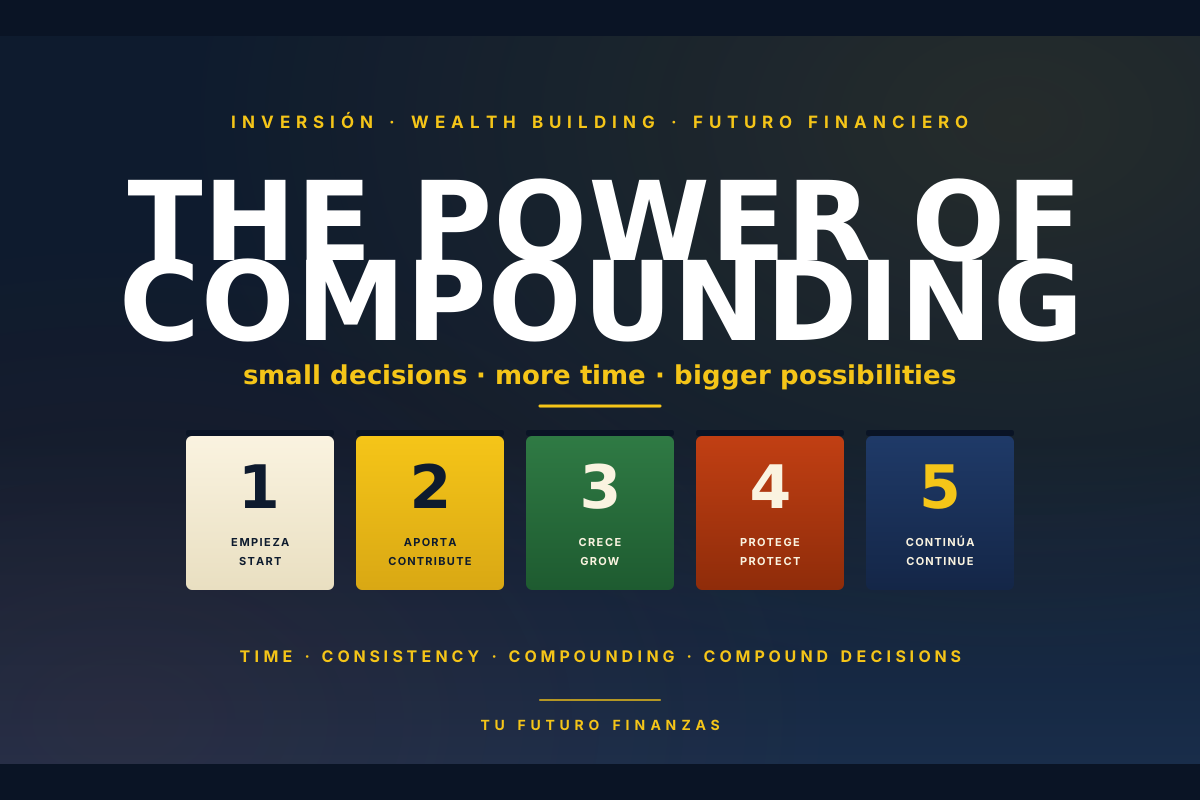
A 5-step educational framework for thinking about compounding in your own life — not a universal formula or a product recommendation.
Before the perfect amount, open the account and make the first contribution.
Schedule the contribution on the day income arrives.
Small regular contributions beat big occasional ones.
Downturns are part of it — a long horizon is your ally.
Raise the contribution with each raise; review fees and inflation.
Adjust the four inputs and see how the hypothetical future balance changes. All calculations happen in your browser — nothing is sent to any server.
Educational model: ordinary-annuity formula with monthly compounding and end-of-month contributions. Actual returns vary with the market and are not guaranteed. Does not include taxes, fees or inflation.
Want to explore more scenarios? Try the Compound Interest Visualizer.
The framework also applies to:
Eight questions — no score. Pick what best describes your situation. When done, you'll see a general reflection, never a grade.

Pick an option for each question and press "See my reflection." This is not a score — it's a mirror.
Pick one thing for the next 4 weeks. Progress > perfection. Your pick is stored only in this tab — it clears when the browser closes.
You haven't picked yet.
Pick a starting point — or write your own. FUTURO is a bilingual educational assistant; it does not replace an accredited professional.
You don't need a big salary for compounding to start working. You need a decision — then another, then another. Small, regular, patient. The hard part isn't the arithmetic. It's the consistency when nothing seems to be happening yet.
The best time to start was ten years ago. The second-best time is today.
Knowledge. Preparation. Progress. One informed decision at a time.
Talk to a bilingual coach — free, no strings attached, educationally focused.
Book your session →