Want to build a clear plan for what happens after your income arrives?
Talk to a bilingual coach — free, no strings attached, educationally focused.
Book your session →
A bigger paycheck can help. But what you do with the money you earn can matter even more. Your salary tells you how much money comes in. It doesn't tell you what happens after it arrives.
Picture two families in the same city, with similar-aged children, same cost of living. Family A earns $90,000 a year. Family B earns $180,000 a year — twice as much.
This isn't a story of "good" versus "bad." We don't know either family's personal history — taxes, household size, health, family obligations, debt or inheritance. And Family B may have very valid reasons for its situation. What this educational example shows is simpler: your salary tells us how much money comes in. It doesn't tell us what happens after it arrives.
Neither column is "wrong." The TODAY column funds your present life — and that matters. The TOMORROW column funds your future life — and that matters too. The educational question isn't which to pick — it's how much of each raise you're directing on purpose.
Think of money as a system with two parts: what comes in and what it becomes. Salary is the first part. What it becomes in your financial life is the second. Two illustrative examples:
Directs roughly $5,000/year toward future goals (retirement, emergency, investing, debt reduction).
Directs roughly $12,000/year toward future goals.
This example does NOT establish that Person B is healthier financially. We don't know taxes, household size, medical obligations, inherited debt, work history or family responsibilities. All it illustrates is a simple idea: two people with very different incomes can be building very different things — sometimes the opposite of what the salary number would suggest.
A raise isn't "free money" — it's a chance to decide. Many households discover that every raise from the past 5 years quietly "dissolved" into spending they don't remember choosing. When a raise arrives without a plan, it defaults to the lifestyle bucket. When it arrives with a plan, it can strengthen today and tomorrow at the same time.
Decision #2 · Financial Breathing RoomYour Financial Breathing Room is the money left each month after covering everything essential. Formula:
TAKE-HOME INCOME − HOUSING − ESSENTIALS − DEBT − INSURANCE − TRANSPORT − FAMILY − OTHER = FINANCIAL BREATHING ROOM
"Can You Afford the House — or Just the Mortgage?"" data-es="Un margen sano permite tomar las decisiones que aparecen más abajo. Un margen ajustado convierte cada mes en una carrera. Este marco es el mismo que exploramos con detalle en el artículo «¿Puedes pagar la casa — o solamente la hipoteca?»."> A healthy Breathing Room enables all the decisions below. A tight one turns every month into a race. This is the same framework we explore in detail in "Can You Afford the House — or Just the Mortgage?"
Think about your most recent raise — 5%, 10%, more, whatever you can recall. Roughly, where did it go? Pick what best describes what happened — not what "should" have happened.

Pick an option to begin. This test has no score and no "right" answer — it's a mirror, not a judge.
Last year's paychecks already arrived. The educational question isn't how much you earned — it's what remains today from all of it. Net worth, emergency savings, remaining debt, retirement contributions and productive assets tell a more complete story than a salary number.
A healthy emergency fund — many families aim for 3–6 months of essential expenses — is what keeps a surprise from becoming debt. There's no universal rule, but a total lack of buffer usually signals financial fragility regardless of income.
Compounding is a simple educational concept: money invested earlier can spend more years working. An illustrative example, with no return guarantee: $200/month for 30 years at an illustrative 7% annual return can become roughly $242,000 — of which $72,000 is contributions and the rest is potential growth. Actual returns vary and are not guaranteed.
Many people reach their peak earnings in a life stage — 40s, 50s, or a business peak. Those years are a window. If lifestyle absorbs the entire raise, the window closes without building anything lasting. If a portion is directed to assets and liquidity, the window leaves a footprint far beyond the year.
The car, the house, the brand, the visible trip — signals the world reads as wealth. But a family's financial reality rarely shows on the outside. A modest home can coexist with real wealth. A luxurious home can coexist with tight debt. It's not a moral judgment — it's just a fact. Every family decides where to put its energy.
Assets are things that, over time, can produce value, income or both — a 401(k), a Roth IRA, a taxable investment account, a home being paid off, a small business. Building assets doesn't require waiting for the next raise. It requires directing a steady portion — even a small one — of the income that already arrives.
Appropriate insurance (health, term life if others rely on your income, disability, property, auto, umbrella when applicable) and basic documents (will, financial power of attorney, health-care directive) protect everything you're building. No universal formula — but a total absence tends to be a quiet fragility.
The biggest question isn't "how much do I want to earn" — it's "what for." Kids' education, retirement with options, family help, generosity, a business of your own, time with people you love. When the what-for is clear, every raise and every decision has a place to go.
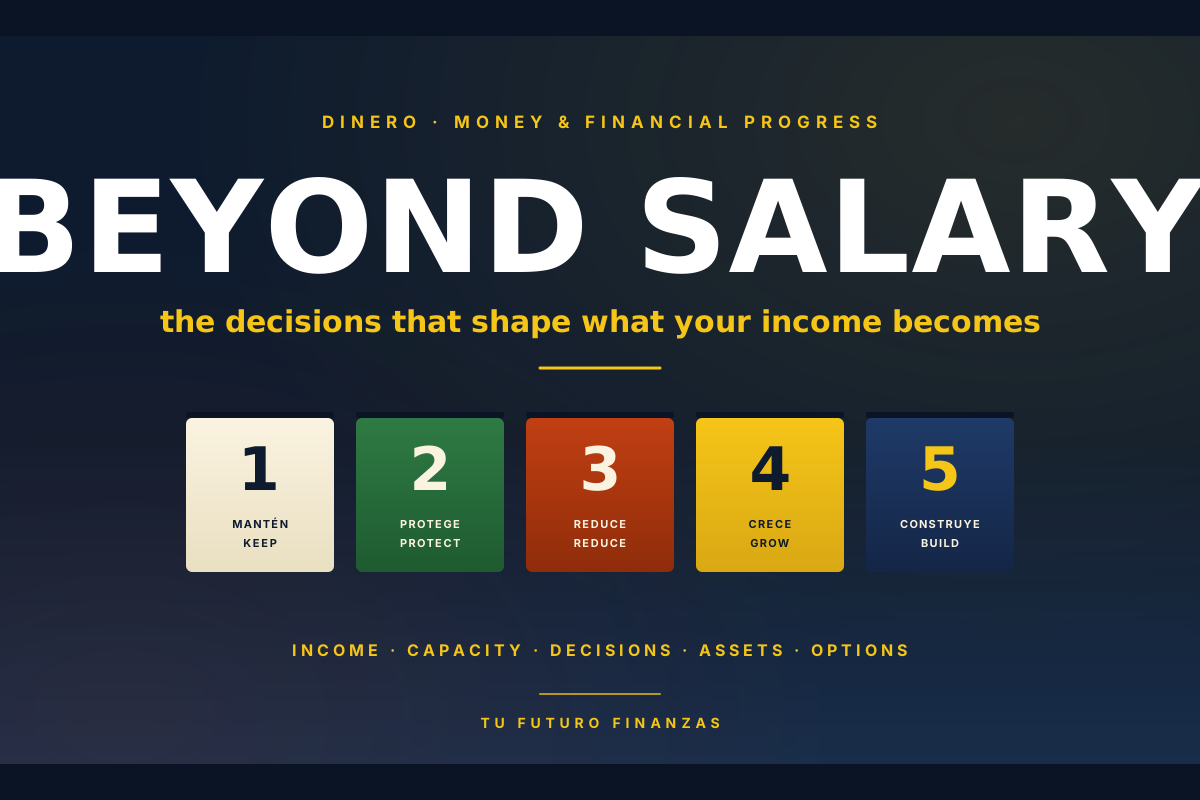
An educational framework for seeing what happens to your income after it arrives. Five steps that convert income into options.
Retain more of what you earn — budget, taxes, fixed costs.
Emergency fund and appropriate insurance.
Cut expensive debt that erodes flexibility.
Invest with long horizon — 401(k), IRA, taxable.
Turn the system into assets that unlock options.
An educational model, not a universal formula. Every family calibrates the steps to its stage, culture and priorities.
Imagine that starting tomorrow you receive $1,000 more per month. Split the $1,000 across these five categories. No right answer — it's a mirror. The last four are future-focused.
Contributions only. No returns, losses, taxes or withdrawals are assumed. Actual returns vary and are not guaranteed.
You chose to direct $800 toward future-focused goals. What would need to happen for that decision to become automatic when your next raise arrives?
Imagine that each month you receive $100 and that number represents all your income. How would you split it across these six categories? We're not trying to account for every coffee — we're trying to understand what your income is becoming.
There are no universal percentages. This exercise shows where your income is landing — so you can decide with more intention.
Two people — call them Person A and Person B — each earn $100,000 a year. Their financial routines look like this:
This example does not declare Person A "better." Person B may have lived through events that made saving very hard; may be supporting another family; may carry medical history; the card may have been a reasonable choice at the time. Their salaries tell the same story. Their financial systems do not. And over time, the system — not the salary — is what decides what gets built.
This article is not a "doesn't matter what you earn, just make better decisions" message. That oversimplification is unfair and false. There are realities — health, family care, work history, structural discrimination, inherited debt, low-paying industries, obligations to send money home — that make the most responsible decision still not enough to close the month.
Income matters. Educational pathways to increase it — none equally available to everyone, and none guaranteed:
Income determines how much enters the system. Your financial decisions influence what that income becomes. Both matter.
Eight questions to revisit with yourself — no score, no grade. These aren't "areas where you're failing." They're questions worth asking.
Pick one thing for the next 4 weeks. Progress > perfection. Your pick is only stored in this tab — it's cleared when the browser closes.
You haven't picked yet.
Pick one of these starting points — or write your own. FUTURO is a bilingual educational assistant — it does not replace an accredited professional.
A bigger paycheck opens doors. A smaller one can close them. And yet — within the range you can influence today — the decisions you make with the money already coming in can move much more than a single raise suggests.
Your salary tells you how much money comes in. Your decisions help determine what happens next.
Knowledge. Preparation. Progress. One informed decision at a time.
Talk to a bilingual coach — free, no strings attached, educationally focused.
Book your session →