How to Pay Off Credit Card Debt — and Build a Financial System That Keeps You From Going Back
A Debt X-Ray, your Debt Freedom Number, and a personalized roadmap — all calculated in your browser, without sending your numbers anywhere.
Tayde Aburto, MBA·August 21, 2026·22 min read·With FUTURO
Imagine this. After two years of consistent effort, you finish paying off $12,000 in credit card debt. You close the last account with a mix of pride and relief. You feel like you finally got control back.
Five months later, the car breaks down. The repair costs $2,300. You have no savings. You put it on a card. The next month, the air conditioning stops working. Another repair. Another charge. A year later, your balance went from $0 to $8,400 — and the feeling of control is gone.
This story isn't a personal failure. It's what happens when you pay off the debt without building the system that keeps it from coming back. This article helps you do both.
The framework
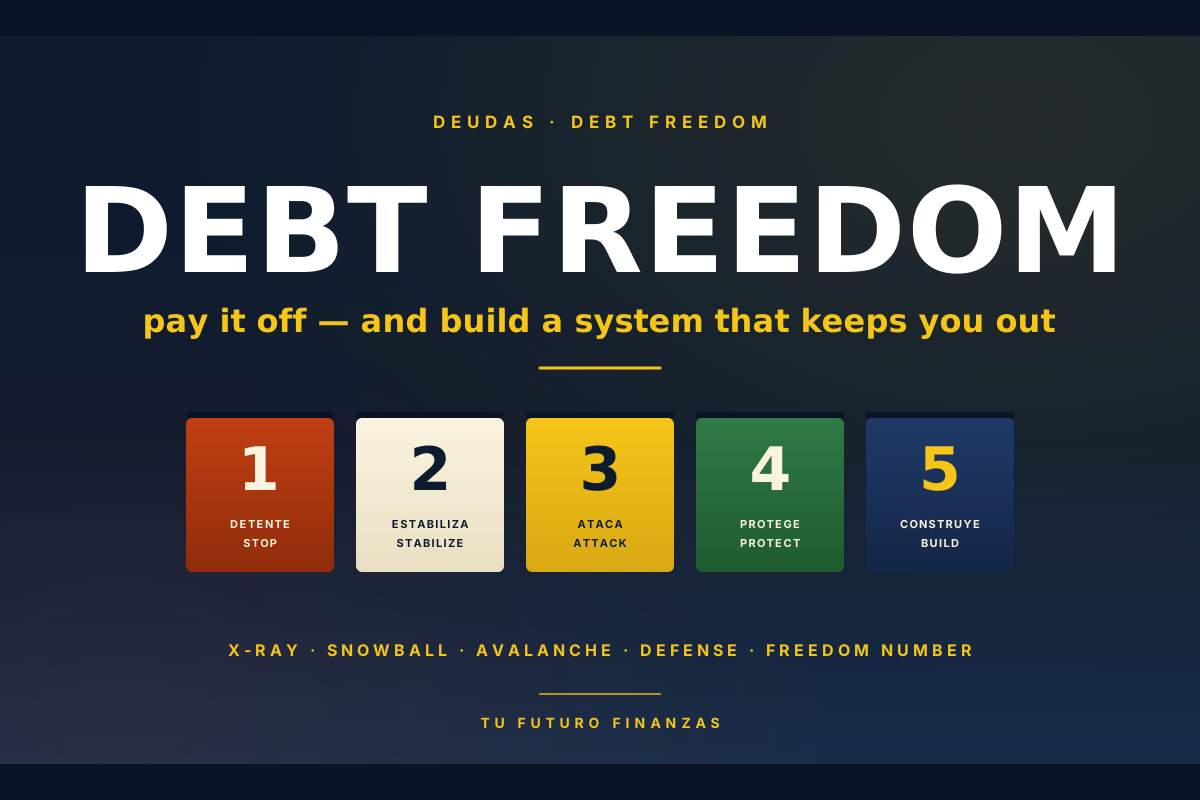
Five stages — not five quick steps
01
STOP
Stop adding. See your numbers as they are.
02
STABILIZE
Understand what produced the balance and stabilize your cash flow.
03
ATTACK
Choose your strategy — snowball, avalanche, or mixed.
04
PROTECT
Build a defense fund and guard against scams.
05
BUILD
Give your old payment a new job — building your future.
Stage 1 · STOP
First, stop arguing with reality
Household credit card balances in the United States have grown substantially in recent years, according to Federal Reserve data. Millions of hardworking, responsible, careful families carry a balance from month to month. You are not alone, and you are not broken.
Credit card debt is expensive by design. The minimum payment — usually 1% to 3% of the balance plus the month's interest — is built so that most of each dollar covers interest, not principal. That is what makes a balance look stuck even when you are paying every month.
1. Your Debt X-Ray
Enter one row per card. We will never ask for the card number, CVV or bank credentials. Everything is calculated in your browser.
Total debt
$0
Sum of balances
Weighted average APR
0%
Weighted by balance
Total minimum payments
$0
Monthly sum
First-month interest (approx.)
$0
Educational approximation
Where your minimum payment goes this month:
Interest$0 · 50%
Principal$0 · 50%
Simplified calculation: monthly interest ≈ balance × APR ÷ 12. Real statements may use average daily balance and different billing cycles.
FUTURO moment
Enter your cards above and press Calculate. I'll show you, without judgment, how much of your monthly payment may be going to interest this month.
2. The minimum-payment trap — two scenarios
Use the total debt and weighted APR you calculated above. Compare: paying roughly the minimum each month, or paying an accelerated amount you choose.
Scenario
Months to pay off
Total interest
Assumed monthly payment
Paying roughly the minimum
—
—
—
Paying the accelerated amount
—
—
—
“Minimum” assumption: max(entered minimum, 1% of balance + monthly interest, $25). Standard amortization with a constant APR and no new charges. For educational purposes only.
Which kind of progress motivates you most?
There is no right answer. Only answers that fit how you work best. This question shapes the strategy you'll explore below.
FUTURO
Stage 2 · STABILIZE
3. What's behind your balance?
Select all that apply. This is educational — not a diagnosis. FUTURO uses your selection to offer teaching context, not a label.
And one question about your cash flow:
If you stopped using your credit cards today, would your monthly income cover your regular expenses?
FUTURO explains
Stage 3 · ATTACK
4. Snowball vs. avalanche lab
Snowball pays the smallest balance first (emotional wins). Avalanche pays the highest APR first (less total interest). Uses the cards you entered above.
Strategy
First card eliminated
Debt-free date
Total interest
Snowball
—
—
—
Avalanche
—
—
—
Assumption: you pay all minimums, then apply the surplus to a single target card by strategy. When one card is paid off, its minimum joins the attack.
5. Your Debt Freedom Number
Pick a horizon. We calculate the monthly payment needed to reach $0 in that time — and the gap between that and what you already pay.
Debt Freedom Number
$0/mo
Your current minimum payment
$0
Additional gap needed
$0
Total interest (approx.)
$0
A reframe that changes the conversation: You don't need to find $18,000. Your immediate problem may be: can you create $0 more per month in your cash flow?
This is information — not failure.
If the required payment doesn't fit your current budget, it doesn't mean you failed. It means that specific horizon isn't the right one. Try more months, review the Move the debt options below, or consider talking with a nonprofit credit counseling agency.
Standard amortization formula: PMT = P × ( r ÷ (1 − (1+r)^(−n)) ), where P = total balance, r = monthly rate (APR ÷ 12), n = months. Educational only.
Move the debt — when it can help and when it can trip you up
There are three common ways to move credit card debt: (1) a 0% APR balance transfer, (2) a personal or debt consolidation loan, and (3) simply paying the existing cards down with new money. Each one changes the structure of your debt — not the reason it appeared.
Balance transfer: there is typically a transfer fee (often 3%–5% of the amount), a promotional APR (0% for 12–21 months in many cases) and a much higher APR after the promo ends. It only helps if you can pay off most of the balance before the 0% expires.
Personal / consolidation loan: fixed APR, origination fee (typically 1%–8%), defined term (2–7 years). Can convert several debts into one fixed monthly payment and often into a lower APR — if your credit qualifies.
Lowering the cost of debt can help. Moving the debt without changing the system that created it may not.
The common story: someone transfers $5,000 to a 0% card and, without meaning to, starts using the old cards again — which now have empty room. Twelve months later, there is $5,000 on the new card and $3,000 on the old ones. The debt moved; it also doubled. This article does not tell you which product to choose. It helps you ask better.
6. Move-the-debt decision lab
Compare — educationally — three routes. Results are not an offer or a recommendation.
Route
Upfront fee
Total interest (approx.)
Balance at end of promo
Months to pay off
Stay on current cards
$0
—
—
—
Balance transfer (0% promo)
—
—
—
—
Personal / consolidation loan
—
—
—
—
This lab does not evaluate your eligibility or recommend a specific product or lender. Check the real terms before deciding. Educational only.
Before you call your credit-card company
Many issuers have internal hardship programs that are rarely advertised. There is no guarantee they will grant them — but asking costs nothing and often goes further than people expect.
Useful questions to ask:
Is there a hardship program I might qualify for?
Can you reduce my APR — even temporarily?
Can I set up a temporary payment arrangement (say, 3–6 months)?
Can you waive the late fee or over-limit fee?
If I accept this arrangement, how will my account be reported to the credit bureaus?
Would the account be closed, or stay open with new terms?
Prepare for the call
Write short answers. FUTURO uses this context to prepare a personalized script, without sending your numbers outside your browser.
When payments are no longer manageable
There are points where a personal plan, no matter how well built, is no longer enough. That is not a moral failure. It is information. And in the United States, there are legal and educational paths for those moments.
Nonprofit credit counseling: accredited agencies offer free or low-cost sessions. They can help you set up a Debt Management Plan (DMP) with consolidated payments and reduced APRs negotiated directly with your creditors. Verify the agency is accredited (for example, by NFCC or FCAA).
Debt settlement programs: commercial companies promise to negotiate your debt for less than the full amount. In practice, they typically ask you to stop paying for months (which harms credit and can trigger lawsuits), charge high fees, and there is no guarantee of success. Forgiven debt is often taxable income.
Bankruptcy: it is a legal process — not a moral label. Two forms are common for consumers: Chapter 7 (liquidation) and Chapter 13 (3–5 year repayment plan). It is a decision with real consequences and real benefits. Talk with an accredited bankruptcy attorney before ruling it out or opting for it.
We cannot recommend a specific agency, company, or attorney. We can help you ask the right questions and arrive informed.
Stage 4 · PROTECT
Debt-relief scam protection
The CFPB (Consumer Financial Protection Bureau) and the FTC (Federal Trade Commission) point to several recurring scam patterns. Treat each one as a red flag:
They ask for a payment before negotiating anything for you (federal law prohibits upfront fees from telemarketing debt-relief companies).
They promise to “erase your debt” or “guarantee” a result — no one can guarantee that.
They tell you to stop communicating with your creditors or ignore lawsuits.
They pose as a government debt-forgiveness program that does not exist.
Pressure to decide “today” without giving you time to read the contract.
Debt Defense Fund — the buffer that stops the bounce
A starter emergency fund ($500–$1,000) does not replace the full emergency fund (3–6 months of expenses). It is the shield that keeps the next tire, prescription, or A/C repair from putting you back on the card.
Where might your first $500 come from?
And the next $500 to reach $1,000?
Two possible journeys
Fragile plan
Pay off $12,000 in card debt.
Don't build an emergency fund.
An unexpected expense appears (car, health).
The card absorbs the hit.
12 months later the balance is high again.
Protected plan
Before accelerating, set aside $500–$1,000.
Apply snowball or avalanche.
An unexpected expense appears — the fund covers it.
Refill the fund, keep the plan.
When done, the monthly payment frees capacity to invest.
7. What changes if...? — quick lab
Uses the debt and APR from above. Tap a button to see, at a glance, how the timeline and total interest change.
FUTURO
Don't sacrifice the wrong things
An aggressive plan works for 6, 12, 24 months — not forever. Paying off debt should not cost you irrecoverable things. Priorities that stay in place even while you attack the debt:
Basic health — prescriptions, checkups, mental health. A neglected problem costs more.
401(k) contribution up to employer match — free money that doesn't come back.
Minimum defense fund — so the next emergency doesn't return to the card.
Relationships — family meals, time with kids, emotional support.
Basic education and career development — courses and certifications that grow your income.
Stage 5 · BUILD
8. Give your old payment a new job
When the debt is gone, your old monthly payment is already proven — you know it fits. Redirect it intentionally. Percentages must total 100%.
%
%
%
%
%
%
%
%
%
%
%
Total: 100% — $400.00
Before (debt) → After (future)
Before: 100% debt
After: 100% future
Your personalized roadmap — 6 cards
Generated from your answers above. The language is always may be worth exploring — never you should. This is educational material, not personalized advice.
Talk with FUTURO about your situation
Pick one of these starting points or write your own. FUTURO is a bilingual educational assistant — it does not replace professional legal or financial advice.
Getting out of debt isn't only about paying for your past. It's about freeing up money for your future. Your goal isn't just $0 in credit-card debt. Your goal is to build a financial life where expensive debt no longer controls what happens next. Knowledge. Preparation. Progress. One informed decision at a time.
Want to build a plan that includes your cards — and everything else?
Talk to a bilingual coach — free, no strings attached, educationally focused.