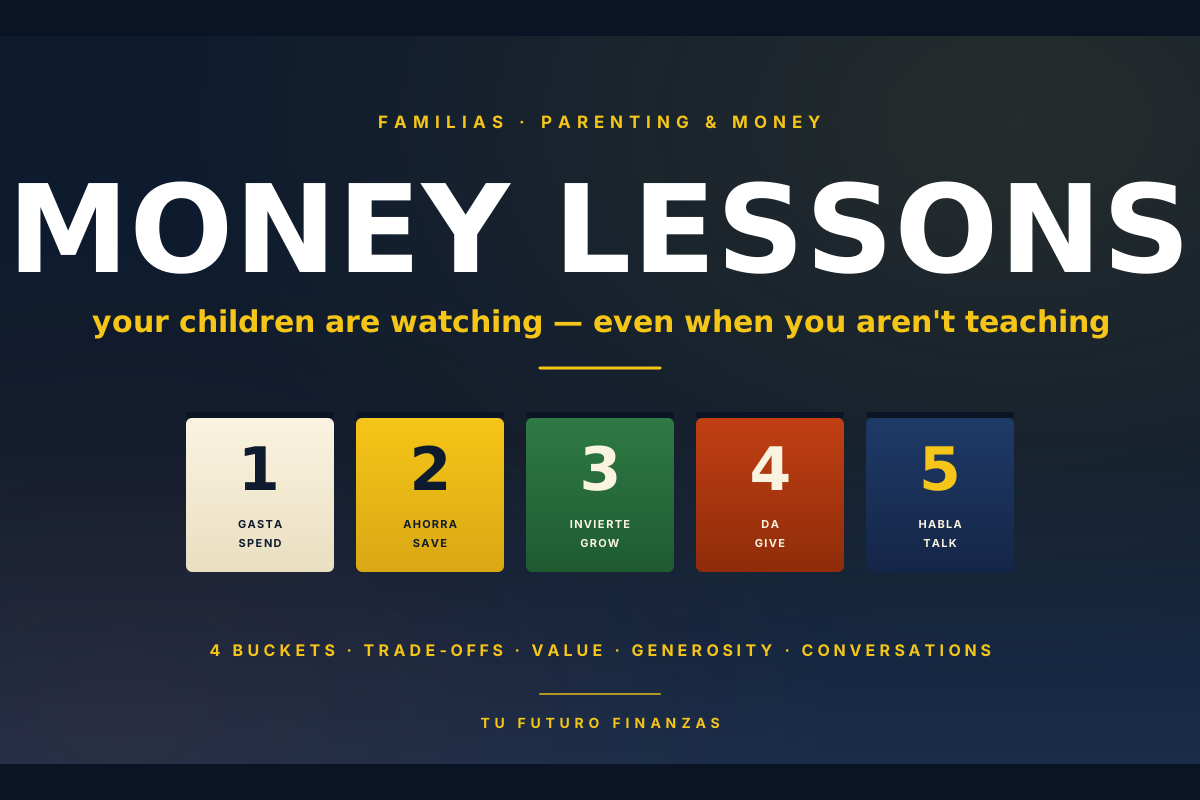
Your Children Are Learning About Money From You — Even When You're Not Teaching Them
A simple family system, lessons by age, a reflective check-in, a 7-day challenge and a monthly conversation — so the next generation grows up with knowledge, not anxiety.
Tayde Aburto, MBA·August 21, 2026·15 min read·With FUTURO
Your children may not remember every conversation you have with them about money. But they are watching…
When a bill arrives in the mail.
When your tone of voice shifts as you talk about money.
When you talk about people who have more — or less — money than your family.
When you decide to buy something calmly or on impulse.
When money creates tension in the home — or secrecy, or confidence.
When they see generosity, fear, calm or anxiety around money.
They are learning what money means long before they understand what money is.
"And that's why one of the most important financial lessons you give your children may never happen at a kitchen table. It may happen simply by the way you live."
FUTURO's first question
FUTURO asks
If your children copied the financial habits they see in your home today, which ones would you hope they keep — and which ones would you want them to change?
It isn't a question to punish yourself with. It's a question to begin with. In this article you'll find simple tools to live more intentionally in front of your children — and to talk about money as a family, with peace and with knowledge.
1 · Emotional meaning
Children Learn the Emotional Meaning of Money First
Before they understand what a credit card, a loan or a paycheck is, your children are already associating money with emotions. Listen to what they learn just from being near you:
Tension.
Relief.
Shame.
Pride.
Fear.
Confidence.
Scarcity.
Enoughness.
A child who hears "we can't afford anything" learns one thing. A child who hears "that's not where we're choosing to spend our money right now" learns something very different. Both statements describe the same reality — but one teaches powerlessness and the other teaches intentional choice.
FUTURO says
Children absorb the emotional climate of your home long before formal lessons. What you feel when you pay the bills is the first thing they learn — even if you never explain a word.
2 · Trade-offs
"We Can't Afford It" Isn't Always the Best Lesson
When a child asks for something — a toy, an outing, a brand — and the automatic answer is "we can't afford it," the message they receive is that money rules and that you have no options. But almost every family money decision is really a trade-off — swapping one thing for another.
Teaching a child the idea of opportunity cost — "if we buy this, we won't be able to do that" — gives them a tool for life. It shows that you choose — not that you're trapped.
3 · See decisions
Let Them See Some of the Decisions
They don't need to see everything — not every topic is age-appropriate. But let them see what they can see:
How you compare prices at the store.
How you decide between two similar products.
How you wait to make a big purchase.
How you save together for a family goal.
How you talk about an expense that didn't go as planned.
How you say "no" to something you want to pick something that matters more.
How you give without needing anyone to see.
How you recover when something costs more than expected.
How you celebrate a goal reached — small or large.
4 · Family Money System
Don't Only Teach Saving. Teach Purpose.
Many homes teach "save part of it." It's a good start — but purpose is a more powerful teacher than saving. When a child sees that their money can do four different jobs, they stop seeing money as a number and start seeing it as a tool.
The TFF Family Money System
Four simple buckets a child can understand — and an adult can too:
SPEND: what gets used now, on purpose.
SAVE: what gets set aside for a specific goal with a name.
GROW: what gets put to work for the long term — the first seed of the concept of investing.
GIVE: what gets shared with others — family, community, a cause.
A simple educational example: if the child receives $10, they might split it into $4 to spend, $3 to save toward a goal, $2 to grow (a jar that isn't opened until later), and $1 to give. These aren't universal percentages — they're a starting point for a conversation.
Split an amount across the 4 buckets
Enter the starting amount. Adjust each bucket. The bar shows the mix. The sum must match the total.
SpendNow, on purpose
SaveFor a named goal
GrowFor the long term
GiveFor others
Spend 40%
Save 30%
Grow 20%
Give 10%
Perfect — the sum matches the total.
These numbers aren't rules — they're a starting point for a conversation. Every family decides which mix makes sense for their culture, goals and stage.
5 · Small mistakes
Let Your Children Make Small Financial Mistakes
It's better for a teenager to lose $45 learning that a product wasn't worth it than for a 25-year-old adult to lose $4,500 learning it for the first time. Cheap mistakes are the most expensive lessons you won't have to pay later.
When it happens — because it will — don't rescue the money. Rescue the lesson. Ask calmly:
What did you expect to happen when you bought it?
What actually happened?
If you had that same amount again, what would you do differently?
FUTURO says
The goal isn't to protect your children from every mistake. The goal is for them to learn to notice, reflect and choose differently — while the stakes are still small.
6 · Waiting has value
Show Them That Waiting Has Value
Delayed gratification isn't an abstract virtue — it's a muscle. And like every muscle, it's trained with small reps.
An educational example: instead of buying the $120 toy today, the family decides to save $10 a week for 12 weeks. At the end, the child doesn't just have the toy — they have the pride of buying it with their own savings. If halfway through they lose interest, they learn something even more valuable: "I didn't want it as much as I thought." And that $35 or $60 already saved becomes the first goal reached for something else.
7 · Earn before spending
Teach Earning Before Teaching Spending
Allowance can be a great educational laboratory — but only if it comes with the experience of earning. Earning changes the relationship with money. When money is effort turned into a bill, it gets spent with more care.
Ideas by age — designed for the stage, not as a universal rule:
Ages 5–8: small one-off tasks that go beyond basic household responsibilities.
Ages 9–12: projects with a "deliverable" — wash the car, water the neighbor's plants, organize a space.
Ages 13–17: first formal job, services (tutoring, babysitting, lawn care), or a small business.
None of these options is "the right one" for every family. Each home decides which mix of responsibility, allowance and paid work makes sense at their stage and in their culture.
8 · First paycheck
The First Paycheck Is a Financial Education Opportunity
When a teenager sees for the first time the difference between what they earned (gross) and what they received (net), they learn in 30 seconds something many adults take years to understand: taxes, withholding, Social Security, Medicare, and — depending on the job — benefits like 401(k) and health.
Additionally — if the teen has reported earned income — they may be eligible to open a Custodial Roth IRA, subject to applicable rules and IRS earned-income requirements. Small amounts contributed early plus compound-interest time can create a big potential impact (with no guaranteed returns).
Instead of saying "don't spend it all," try this question:
"What jobs do you want this paycheck to do?"
That single question changes the frame: from restrict to assign with purpose.
9 · Visible saving
Let Them See You Save for Things
Let's compare two experiences — same destination, different paths:
Experience A — Impulse: they decide tomorrow to go on vacation. Everything on the credit card. The kids see the trip, they see the joy — but they'll also see, months later, the tension of paying it off.
Experience B — Plan: they announce the goal in January. Each month, the family watches the "trip fund" grow. When vacation arrives, they leave debt-free — and the kids lived 6 or 9 months of the process, not just the destination.
In both experiences, the family goes to the same place. But in the second, kids learn that good things are built — not charged to the card.
10 · Price vs. value
Teach the Difference Between Price and Value
An adult who only looks at prices buys cheap. An adult who only looks at brands buys expensive. An adult who learned as a child to look at value buys well.
A simple example: $30 backpack vs. $80 backpack. The conversation isn't "which is cheaper." The conversation is five questions:
How long will each one last?
How often will it be used?
What difference does quality make when using it?
What are you really paying per year or per use?
What do you give up choosing the more expensive one — or the cheaper one?
11 · Advertising
Talk About Advertising
Your children see ads every day — on the phone, on YouTube, in the street, in video games. Advertising has one job: convince them they need something. There's nothing wrong with that — but an educated consumer learns to see that job. Useful questions to ask together in front of an ad:
What emotion is this ad trying to trigger?
What problem is it promising to solve — is that a real problem you have?
What does it really cost — price + time + space + maintenance?
If we waited 3 days, would we still want it?
12 · Wealth isn't the goal
Don't Make Wealth the Goal
Money isn't the goal — it's fuel. The goal is what money makes possible. When you teach your children what money is for, they learn to use it — not to chase it. Nine things money can help create:
Security — a cushion for life's surprises.
Choices — the power to say yes and to say no.
Time — for what matters, not just what's urgent.
Opportunity — to start, to invest, to try.
Education — yours and the next generation's.
Experiences — memories no single purchase matches.
Generosity — the ability to give without it hurting.
Independence — not depending on one person or one situation.
Legacy — what you leave behind — money, values, example.
13 · Empathy
Be Careful How You Talk About Other People's Money
When your children hear you say someone is "rich," "poor," "cheap" or "wasteful," they're learning two things at once: how to categorize people by their money — and how they can expect others to categorize them someday.
Almost every family's financial reality is more complex than what you can see from the outside. A new car can coexist with huge debt. A modest home can coexist with real wealth. Empathy and reserve are part of financial education — not just good manners.
14 · Visible generosity
Let Them See Generosity
Children who see their parents give learn that money can be a tool for others, too. You don't have to announce it — but you also don't have to hide it. Concrete examples a child can see at home:
Helping a family member in a hard month.
Contributing to the community or church.
Buying something specific for someone in need.
Donating to a cause the family picked together.
Gifting time — which is also a kind of giving.
Teaching them to include "Give" in their own Family Money System.
15 · Handling stress
Your Children Are Watching How You Handle Financial Stress
Every home — regardless of income — goes through tight moments. A car that breaks down. An unexpected medical bill. A slow season at work. How the adults react is the part children record.
Response A: yelling, secrets, blame, panic. The child learns money is danger.
Response B: naming the problem calmly, reviewing options, adjusting the plan, moving forward. The child learns money is manageable.
Both homes faced the same difficulty. Only one left the kids a tool for the future.
Lessons by age
Age-appropriate lesson picker
Pick an age group to see curated ideas. They aren't "the right ones" — they're a menu to choose from based on your family.
Educational only. Each family decides what fits them. FUTURO does not recommend specific financial products for children.
16 · Family check-in
FUTURO Family Check-in
Ten reflective questions — no scoring, no grading, no judging. Answer with what feels true today. At the end you'll see some strengths and a few areas to explore this week.
Your reflection for this week
Strengths
To explore this week
This is a reflection tool — not a parenting score.
17 · Monthly conversation
Have a Monthly Family Money Conversation
Once a month — no drama, no specific paycheck numbers unless you want to — the family sits down for 20 minutes to talk. Adjust the questions to your children's ages. The goal isn't to solve anything: the goal is for talking about money to be as normal as talking about food, school and health.
Press the button to draw 3 random questions for this meeting.
Your questions this time
Press "Generate a family conversation" to begin.
18 · One powerful question
One Powerful Question for Every Age
"What am I giving up if I choose this?"
The same question works at three stages — the scale changes, not the frame:
At 6: "If I buy this toy today, what other toy won't I be able to buy this month?"
At 16: "If I spend this whole paycheck going out, what bigger goal am I giving up?"
At 36: "If we pick this house, what financial breathing room — retirement, travel, education — are we giving up for the next several years?"
A single question learned well at 6 becomes a tool at 36.
TFF 7-day challenge
A TFF family challenge
One week. Seven small moments. Check each day when you've done it. Progress is only kept in this tab — reload and you start fresh.
0 of 7 done
Reflect together
What did your family notice about money this week? Take 10 minutes this weekend to share what each person saw, learned or felt. The week isn't over until the conversation happens.
The real lesson
The Lesson You're Really Teaching
In the end, all the techniques — allowance, buckets, conversations, ads — are tools. The deeper lesson is the life they see in you. Children thrive when they can see adults who…
…talk about money calmly — no secrets, no drama.
…make decisions on purpose — not on impulse.
…save for what matters — and celebrate when they arrive.
…give without noise — because they know what money is for.
…own their mistakes without shame — and adjust the plan.
…treat money as a tool — not as an identity.
…invest in the future — their own and the next generation's.
Talk with FUTURO about your family
Pick one of these starting points — or write your own. FUTURO is a bilingual educational assistant — it does not replace an accredited professional.
Your next win
Pick one thing for this week. Progress > perfection.
When you think back to money as a child… what was it? Was it something people fought about? Something nobody discussed? Something that produced fear, or shame, or quiet panic at the end of the month? Or was it simply there — a topic the family handled together, with calm, with knowledge?
Whatever your answer was — you get to decide what your child's answer will be. Not because of what you tell them. Because of what they see.
Money doesn't have to control your future. You can learn how to make informed decisions with it. Knowledge. Preparation. Progress. One informed decision at a time.
Want a family plan that includes money and the kids?
Talk to a bilingual coach — free, no strings attached, educationally focused.